
One property. One decision. $1.7 million in 12 year
The Breaking Point
Twelve years ago, I was stuck in a loop that felt impossible to escape.
I had been a professional for five years after college, earning nearly $80K a year — yet all I had managed to save was $22,000.
Between student loans, car payments, taxes, and bills, every paycheck vanished almost as soon as it hit my account.
I was living in a 300-sq-ft converted garage in a low-income neighborhood in Los Angeles, trying to cut costs — and still felt like I was drowning.
Worse, I was working under a toxic boss. Every day felt like mental quicksand. I wanted out — but every time I looked at my bank balance, escape looked mathematically impossible.
Then one day, something clicked.
For years I’d heard about low-down-payment programs for owner-occupied properties up to four units, but the opportunity never truly registered — until frustration turned into desperation.
That moment of pressure became the spark.
Five years in, $22K saved. A loop I couldn’t escape
The Discovery
I started researching every possible way to buy property without needing $100K in cash. That’s when I discovered a game-changing rule:
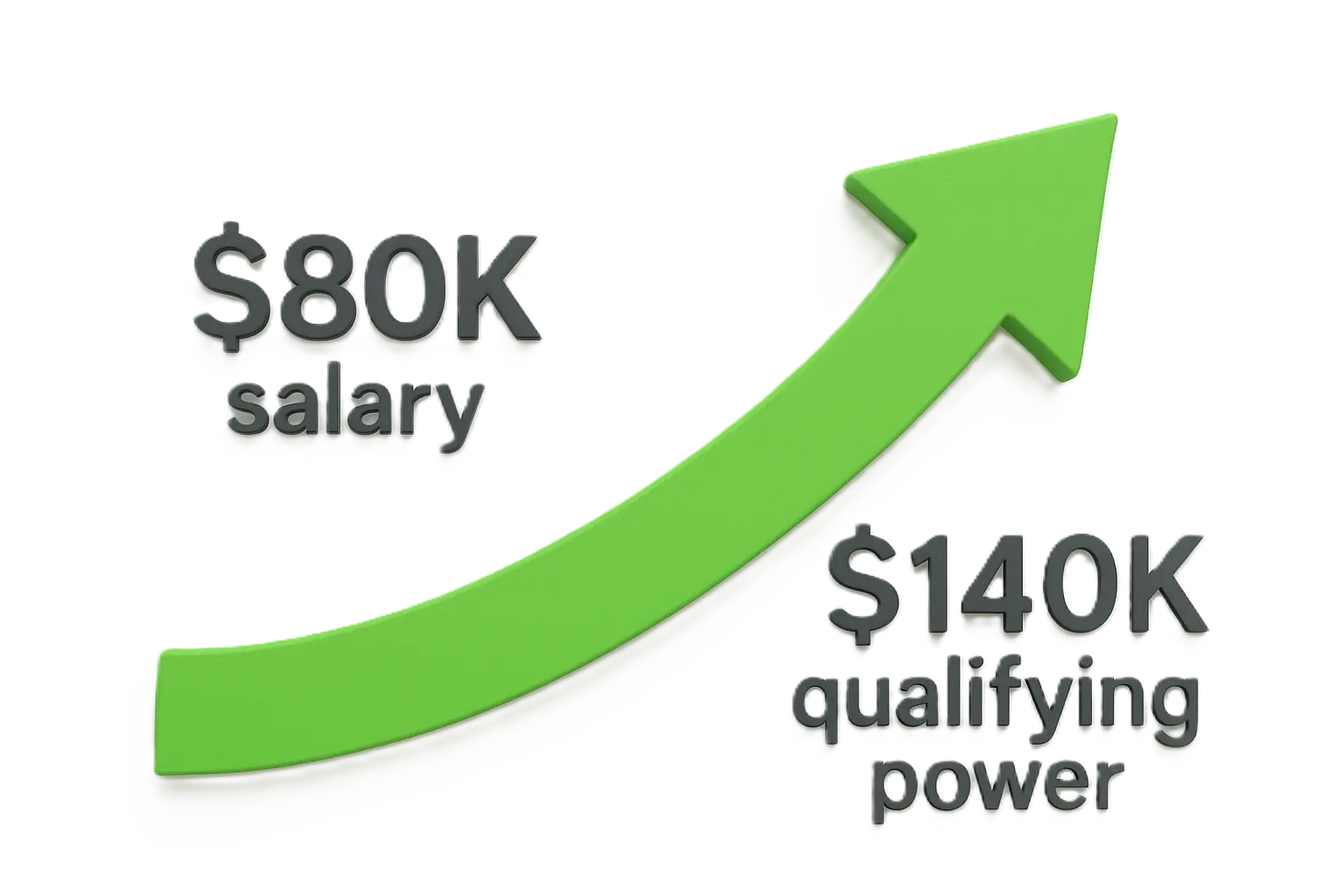
Banks will often count 75% of the rental income from the other units (besides the one you live in) toward your qualifying income.
So when you buy a 4-unit and live in one unit, the rent from the other three actually boosts your income on paper.
If those three units rent for $2,250 each, that’s $6,750 total.
Banks count 75% of that = $5,062.50.
That’s effectively $60,750 of extra income added to your salary — without working a second job.
So, an $80K earner now qualifies like a $140K earner. That’s leverage
After that discovery I got pre-approved, found a real-estate agent who specialized in income properties, and started the hunt for my first real estate investment.
“You don’t need a higher income. You need smarter leverage.”
The Deal That Changed Everything
Property Type: 4-unit multifamily
Purchase Price: $610K
Financing: Low-downpayment owner-occupied loan for 2–4-unit properties
Units: Live in 1, rent 3
When I bought it, the rental units were dated but functional. They brought in $3,743/month in rent. My mortgage and bills totaled about $4,400/month, which meant my cost to live in a 1,750-sq-ft, 3-bedroom, 2.5-bath home was roughly $700–$800 — when market rent for something similar was $2,000.
That was my first victory: living better for less, while building equity every month.
But the bigger unlock wasn’t my reduced housing cost — it was how quickly I could increase the property’s value with simple improvements.
Cleaning and paint are the highest-ROI upgrades in real estate — and sweat equity compounds faster than the stock market ever will.
Here’s how.
A tenant moves out of a unit renting for $2,000/month. You don’t have much cash for renovations, so instead of granite counters and stainless steel, you do the simplest upgrades possible: deep clean, fresh coat of white paint, new knobs and hinges. Total cost? About $300.
But now the unit rents for $2,300/month.
That $300 increase equals $3,600 more income per year — without raising your expenses.
And here’s where the magic clicks: in real estate valuation, income gets capitalized. At a 5% cap rate, an extra $3,600 per year = $72,000 in added property value.
If you invested that same $300 in an index fund at 10% interest, you’d need 57.5 years to hit the same number.

The 2025–2026 Playbook: How You Can Do It Too

Target the Right Markets
Example: Newark, NJ. Just 20 minutes by train to Midtown Manhattan, Newark sits at the intersection of affordability and opportunity. Billions in new developments, infrastructure, and public-funded projects have transformed the market — while prices remain within reach for professionals earning $70K–$80K (including additional units rental income to help qualify).
As of October 2025, here’s what opportunity looks like:
Triplex B — $650K
3 bed / 2 bath + (2) 2 bed / 2 bath apartments + (1) 1 bed / 1 bath apartment
Estimated PITI: ~$4,600/mo
(PITI = Principal + Interest + Property Taxes + Insurance — your total monthly payment to the bank)
Current rent (excluding the unit you would occupy): ~$4,700/mo
→ ~$100/mo spread (before reserves)
After modest renovations (over 2–3 years):
Projected income: ~$6,100/mo
→ ~$1,500/mo spread (before reserves)
Qualifying Income Boost
The two larger apartments generate ~$4,700/mo.
Lenders typically count 75% of that (~$3,525/mo)
≈ $42,300/year added to your income on paper
— without a promotion and without a second job.
Owner-Occupant Strategy
Live in the smallest apartment so the higher-rent units stay leased.
This maximizes both cash flow and lending leverage.
Where the “Quiet Wealth” Kicks In
When your income rises, your property value rises too — because multifamily property is valued based on income, not emotions or comps like a regular house.
Today this property type trades around a 6% cap rate.
As Newark improves and investor confidence rises, cap rates compress
(for example: from 6.0% → 5.75%).
This means you get two layers of appreciation:
- Higher income from renovations
- Higher valuation on that income because the market now rates the area as more desirable
That’s how slow, simple upgrades can quietly snowball into six-figure equity gains without flipping or selling.
(A deeper step-by-step walkthrough of this math — including how a small cap rate shift multiplies value — will be included in the upcoming mini-course.)
THE FIVE ENGINES OF WEALTH

What Is House Hacking?
House hacking is a strategy where you buy a 2–4 unit property, live in one unit, and rent out the others.
Because you occupy the property, lenders treat it as owner-occupied, which unlocks:
- A lower interest rate
- A low down payment
(instead of the 25% required for a non-owner-occupied multifamily)
The rental income helps cover your mortgage while the property builds equity for you — turning your home into a wealth engine instead of a monthly expense.
1. Appreciation — Market value climbs over time.
2. Loan Paydown — Tenants pay your mortgage balance.
3. Cash Flow — Rents exceed expenses.
4. Tax Benefits — Depreciation and deductions increase your effective income.
5. Refinancing Opportunities — Pull out equity as values rise and rates fall.
Together, these create an unstoppable compounding effect — the same one that built my first million and funded everything after it.
The Mindset Shift
Your income is not your limit. Your architecture is.
Looking back, the biggest transformation wasn’t financial — it was mental.
This property gave me something far more valuable than money: leverage. It proved that my 9-to-5 wasn’t a trap — it was a funding source for freedom.
One smart move, executed with discipline, became the cornerstone of everything that followed.
Your income is not your limit. Your architecture is.
The Challenge to You
Would you lower your quality of life now to raise your freedom forever?
The path to financial freedom doesn’t start with luck or six-figure savings — it starts with one intentional decision, made with vision and execution.
Follow @AdvancePages on Instagram and start building the life that doesn’t wait for approval.
Become the kind of person who moves before the world gives permission.
Real frameworks. Real leverage. Quiet results that speak for themselves.
ABOUT THE AUTHOR
K.B. Mac is an international acquisitions consultant based in Manhattan and Tokyo. A graduate of NYU’s Master of Science in Real Estate Development, he has led strategic operations managing multi-billion-dollar projects and teams across continents. Through AdvancePages, he shares systems of thought, leverage, and design for those who want to build scalable lives and intelligent freedom.